

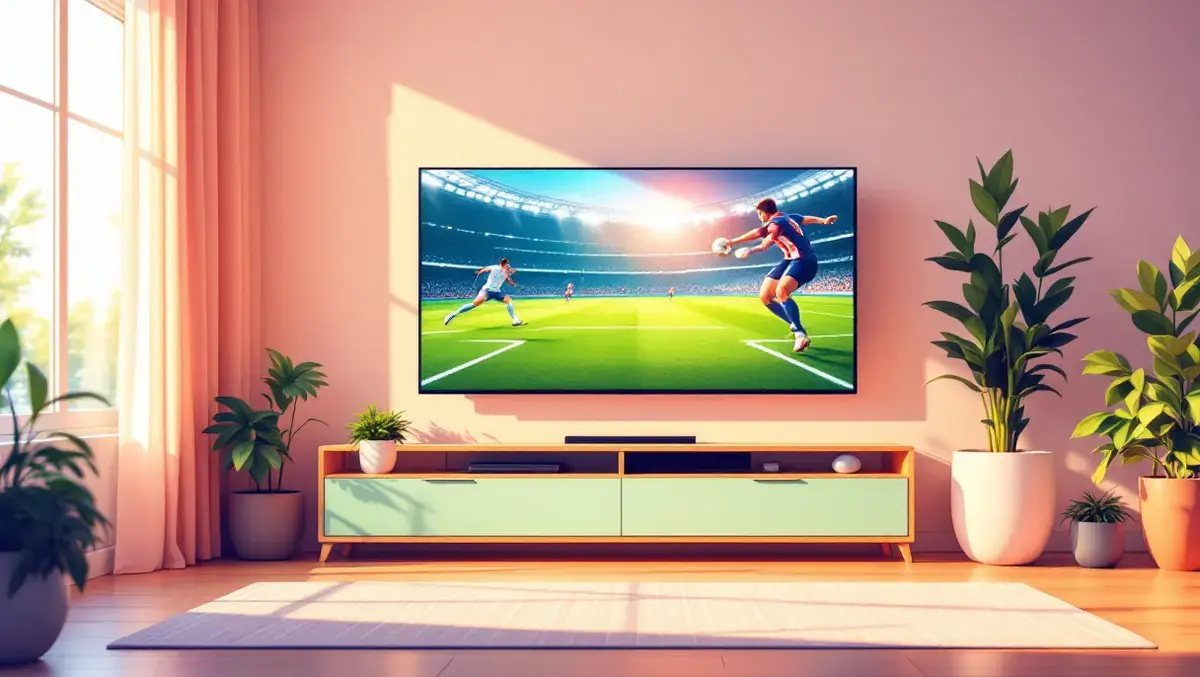
TCL urges sports fans to boost TV brightness for finals
Mon, 31st Aug 2026
TCL is urging sports fans to increase their television brightness during the finals season, particularly for daytime matches watched in bright rooms.
Glare and reflections remain a common problem when afternoon sunlight hits television screens, especially during live sport, when viewers are less willing to interrupt the action to shut curtains, move furniture or change seats.
The recommendation comes as television makers continue to compete on picture quality in the home entertainment market, where brightness, contrast and glare reduction have become key selling points alongside screen size and price. Daytime viewing has become a practical issue for sports audiences because many fixtures are played before evening, when natural light is strongest.
Patrick Chen, Product Training Specialist at TCL Electronics Australia, said screen reflections can affect the viewing experience at a crucial point in the sporting calendar.
"TV blind spots can be a major bugbear for supporters at any time, but with many sporting seasons reaching the sharp end, watching without disruption matters more than ever," Chen said.
He said the problem highlights the need to keep viewing conditions stable during a match rather than adjusting the room once play has started.
"Whether because of unwanted glare or reflections, nobody wants to get up midway through to move the TV, shut the curtains or rustle up some objects to use as shade. You want good memories of the game, not looking the other way when something big happens.
"It might seem odd, but upping the screen's brightness can really give sports fans a clearer and more vibrant picture. It cuts through the glare of the Aussie daytime sun, ensuring a sharp image while delivering a vivid display with deep, bold colours across the spectrum," Chen said.
Viewing conditions
The comments highlight a basic trade-off in television viewing. A brighter screen can make an image easier to see in a sunlit room, but ambient light, room layout and panel finish still affect how distracting reflections are.
Manufacturers have increasingly promoted anti-reflective coatings, higher peak brightness and display technologies designed to preserve contrast in difficult lighting. Those features matter not just for films and gaming but also for live sport, where a fast-moving image can be harder to follow if the screen appears washed out.
Chen said viewers considering a replacement set should pay attention to the display characteristics most relevant to daytime sport.
"You shouldn't have to compromise on colour, contrast or brightness, whatever the viewing conditions," he said.
He also acknowledged that technical measures have limits when direct sunlight is involved.
"But glare can only be mitigated, not eliminated entirely - there's always a trade-off. Beating the sunshine shouldn't come at the cost of a washed-out picture and your team running out in beige or faded team colours.
"Think of it like a beautiful view from your front window - it might get bright, but you wouldn't hide it behind frosted glass. If you're shopping for a TV for the playoffs, look for a set with serious peak brightness credentials - the higher this is, the better it can handle a sunlit room. That's exactly what we've engineered our SQD Mini-LED range to do, combining these brightness credentials with the deep contrast needed to display daytime sport," Chen said.
Market focus
The focus on brightness reflects a broader shift in the television market, where buyers are often asked to compare technical specifications that can be hard to judge in a showroom. Peak brightness has become one of the easier headline figures for brands to market because it speaks directly to visible performance in a bright environment.
For consumers, that measure is only part of the picture. A television's handling of glare also depends on how effectively its panel disperses reflections, how well it maintains dark detail in a bright room and whether stronger illumination affects colour balance.
Sports broadcasting places particular emphasis on those factors because fields, jerseys and score graphics rely on strong contrast and stable colour reproduction. If a room is flooded with daylight, even a large screen can appear dull or mirror-like unless the panel is designed to cope with those conditions.
Australia presents a clear use case for that argument because afternoon light can be intense for much of the year, especially in living rooms with large windows. In that setting, a simple settings change may help some viewers, while others may decide the issue justifies a hardware upgrade.
TCL's message also reflects an effort by television makers to connect product specifications with everyday frustrations rather than abstract engineering benchmarks. In this case, the practical problem is not access to sport but the difficulty of seeing the screen clearly when sunlight competes with the broadcast image.
For viewers sticking with their existing set, the most immediate recommendation is simple: increase screen brightness before rearranging the room. For those in the market for a new display, Chen said to prioritise brightness and glare handling over impressive-looking specifications that do not address daytime viewing. "If you're shopping for a TV for the playoffs, look for a set with serious peak brightness credentials - the higher this is, the better it can handle a sunlit room."