

Gigabyte wins four Red Dot awards for motherboards
Wed, 20th May 2026 (Today)
Gigabyte has won four 2026 Red Dot Design Awards for motherboards in its X870 and X870E range.
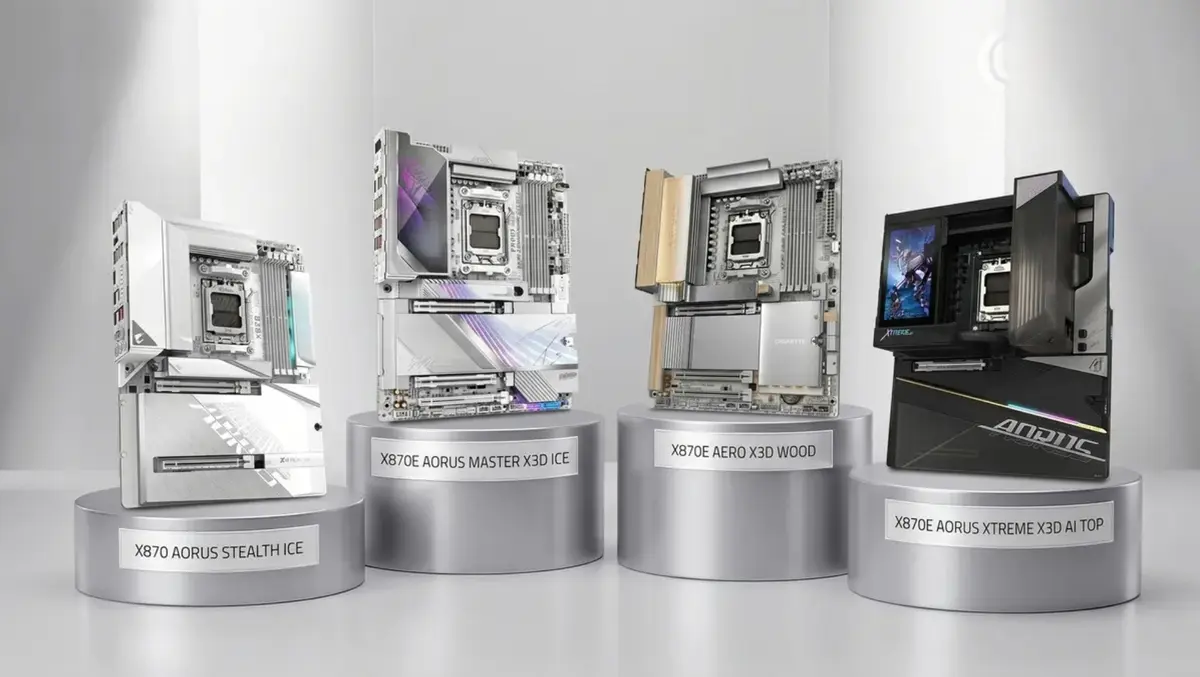
The winners are the X870 AORUS STEALTH ICE, X870E AORUS XTREME X3D AI TOP, X870E AORUS MASTER X3D ICE and X870E AERO X3D WOOD. The awards come from the Red Dot Award: Product Design, an international design competition run by Design Zentrum Nordrhein Westfalen in Essen, Germany.
An independent international jury assesses entries on criteria including innovation, functionality, quality and ecological responsibility. Red Dot says the award recognises products that stand out in both form and function.
Gigabyte's four winning boards showcase different design approaches within the same category. The X870 AORUS STEALTH ICE features a reverse-connector layout and white finish, while the X870E AERO X3D WOOD uses wood-texture accents on its heatsink covers.
The X870E AORUS MASTER X3D ICE also adopts an all-white design, with translucent heatsink accents and a monochromatic look aimed at high-end gaming systems. At the top of the range, the X870E AORUS XTREME X3D AI TOP is positioned as the company's flagship AMD motherboard.
Design focus
The awards highlight a broader shift among motherboard makers toward industrial design as well as technical specifications. In a market long defined by chipset support, memory compatibility and power delivery, vendors are increasingly trying to stand out through styling, cable management and build aesthetics.
That shift is especially clear in products such as the STEALTH ICE, which moves connectors to the rear of the board. Gigabyte says this layout is intended to create a cleaner internal build, improve airflow and make assembly easier for PC builders.
Broad chassis compatibility is another part of that strategy. The board works with cases from numerous manufacturers, reflecting a wider push in the DIY PC market to support hidden-cable builds without locking buyers into a single enclosure ecosystem.
Elsewhere, the AERO X3D WOOD takes a more distinctive approach, introducing wood-texture detailing to a category usually dominated by metal finishes and exposed circuit elements. Gigabyte positions it at creators, artists and professionals who want workstation hardware with a more personalised visual identity.
Performance claims
Alongside their design features, the boards include performance functions tied to AMD Ryzen 3D V-Cache processors. Several use Gigabyte's X3D Turbo Mode 2.0 technology to tune settings automatically for gaming and other workloads.
For the X870E AORUS XTREME X3D AI TOP, Gigabyte claims X3D Turbo Mode 2.0 can deliver up to 25% more gaming performance from supported AMD processors through adaptive tuning. The board is also described as an AI TOP-certified platform for buyers seeking a single system for gaming and professional AI workloads.
According to Gigabyte, the same tuning feature is included on the X870E AORUS MASTER X3D ICE and the X870E AERO X3D WOOD. The company says the AERO model is designed to support rendering, simulation, AI inferencing and gaming without manual tuning.
The STEALTH ICE uses X3D Turbo Mode rather than the newer 2.0 version. Gigabyte describes it as a way to automatically unlock the performance of AMD Ryzen 3D V-Cache processors.
Retail availability
The four award-winning motherboards are now available through authorised retailers and distributors in Australia. That gives Gigabyte an opportunity to turn design recognition into sales in a premium segment of the PC hardware market, where enthusiasts and professional users often pay close attention to both looks and specifications.
With four products recognised in the same competition, Gigabyte has gained visibility across several motherboard niches: flagship gaming systems, white-themed builds, creator-focused workstations and cable-minimised PC designs. The spread of winners suggests manufacturers now see design language as a more important part of product strategy in components once judged largely on technical benchmarks alone.
The Red Dot programme has run since 1955 and remains one of the better-known design competitions for consumer and industrial products. Its Product Design category is widely used by hardware makers to signal external recognition for styling, usability and engineering.
Gigabyte says the four boards were recognised for distinct design identities, ranging from the minimalism of the STEALTH ICE to the warmer finish of the AERO X3D WOOD.