Druid AI report finds AI agent use concentrated in key tasks
Thu, 21st May 2026 (Yesterday)
Druid AI has released its 2026 AI Adoption Benchmark Report, based on anonymised production telemetry from live enterprise AI agents across four sectors.
The study examines 15 months of data collected between January 2025 and March 2026 across healthcare, higher education, financial services, and HR and IT. It focuses on how AI agents are used after deployment rather than on executive surveys or stated plans.
The findings show that usage in each sector is concentrated in a narrow set of high-volume tasks. These include customer and student servicing, patient access, and workplace operations, described as the main "front-door" workflows where demand first appears.
In financial services, three workflow types account for 90% of all production volume. In higher education, three workflows account for 92% of usage.
The report argues that this concentration should guide deployment priorities. Organisations should start with high-frequency entry-point interactions before extending AI into more complex workflow orchestration that depends on integrations, policy controls, and structured handoffs to staff.
Resolution metrics
The data also highlights variation in containment rates between sectors. The report argues that these differences matter more than the headline percentages because they reflect decisions about which interactions should be resolved automatically and which should be routed to people.
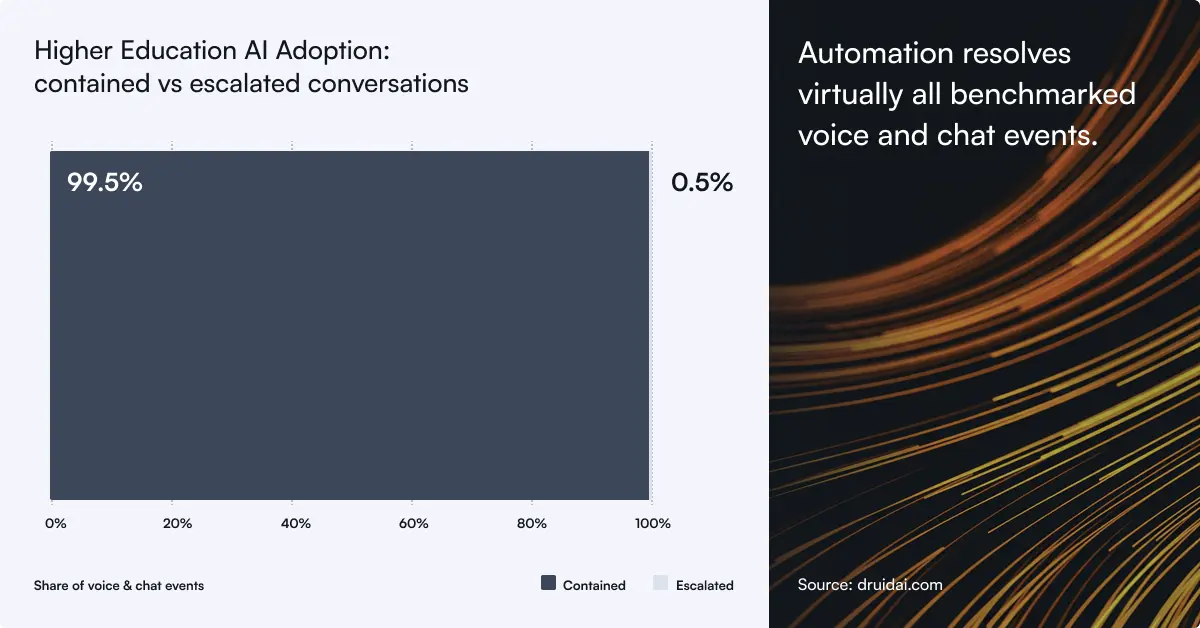
Higher education recorded a 99.5% containment rate, mainly linked to general student enquiries. HR and IT recorded 93%, while healthcare posted 87% and financial services 80%.
In the latter three sectors, lower rates reflect rules requiring human involvement in some cases. These include security approvals and policy exceptions in HR and IT, clinical or policy reviews in healthcare, and risk, compliance, or advisory interactions in financial services.
The report presents "governed resolution" as a more useful measure than deflection alone. In practice, this means an AI agent resolves the work it is designed to handle and passes on the rest with the interaction context intact.
Joseph Kim, Chief Executive Officer of Druid AI, said: "There have been plenty of 'State of AI' reports based on surveys that illustrate current sentiment on Agentic AI. At Druid, we thought it would be more valuable to share what these agents are actually doing once in production. After analysing 15 months of AI agent data across four industries and hundreds of enterprise customers, the patterns in what is working, and how to make it work, are clear."
Different value
The data also points to two distinct operating patterns behind AI adoption. The report describes these as continuity and absorption, depending on when demand arrives and what problem the organisation is trying to solve.
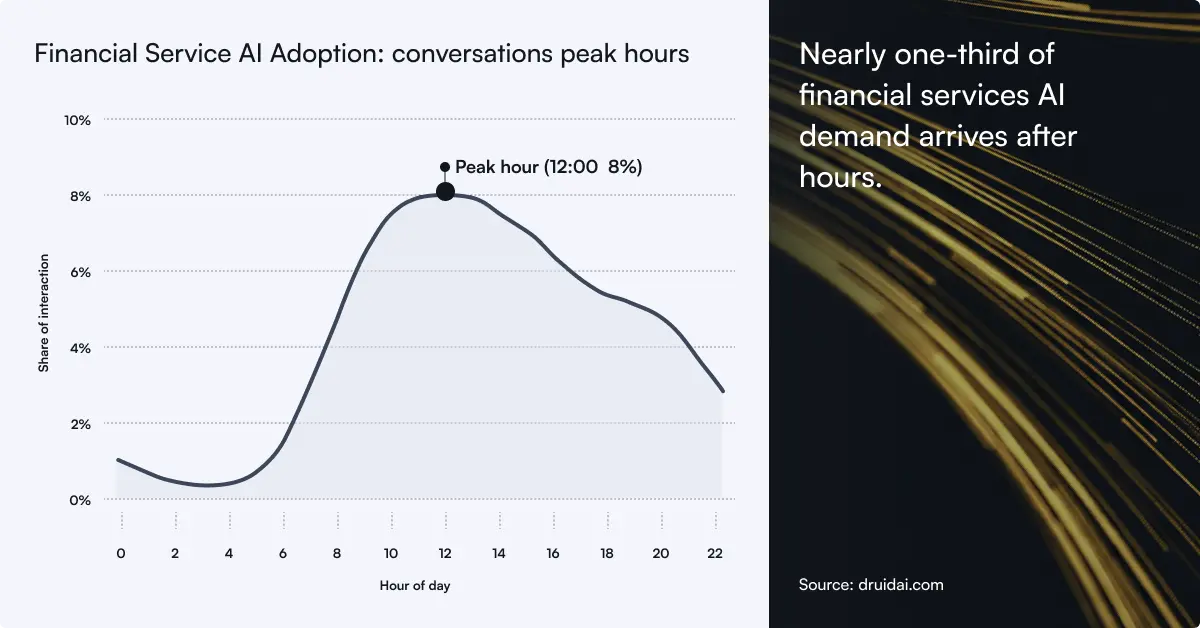
In healthcare, higher education, and financial services, AI is presented as a continuity tool because a substantial share of demand arrives outside standard business hours. Between 29% and 39% of requests in those sectors are made after hours.
HR and IT show a different pattern. Only 6% of demand arrives outside business hours, but 24% comes within the single hour between 9am and 10am. This suggests AI's main role in that environment is to absorb spikes in demand during peak periods.
The report says this distinction should shape how organisations assess returns from AI systems. In sectors with heavy out-of-hours demand, the case centres on service continuity. In workplace support functions, it is more closely tied to handling concentrated volumes without adding staff at busy times.
Druid AI plans to publish the benchmark report annually. The first edition draws on data from what Kim described as hundreds of enterprise customers using AI agents in live production settings.