



Australian shoppers plan to spend more over the Black Friday Cyber Monday period, according to Shopify research. The survey also found that many consumers expect to use artificial intelligence for at least one shopping task.
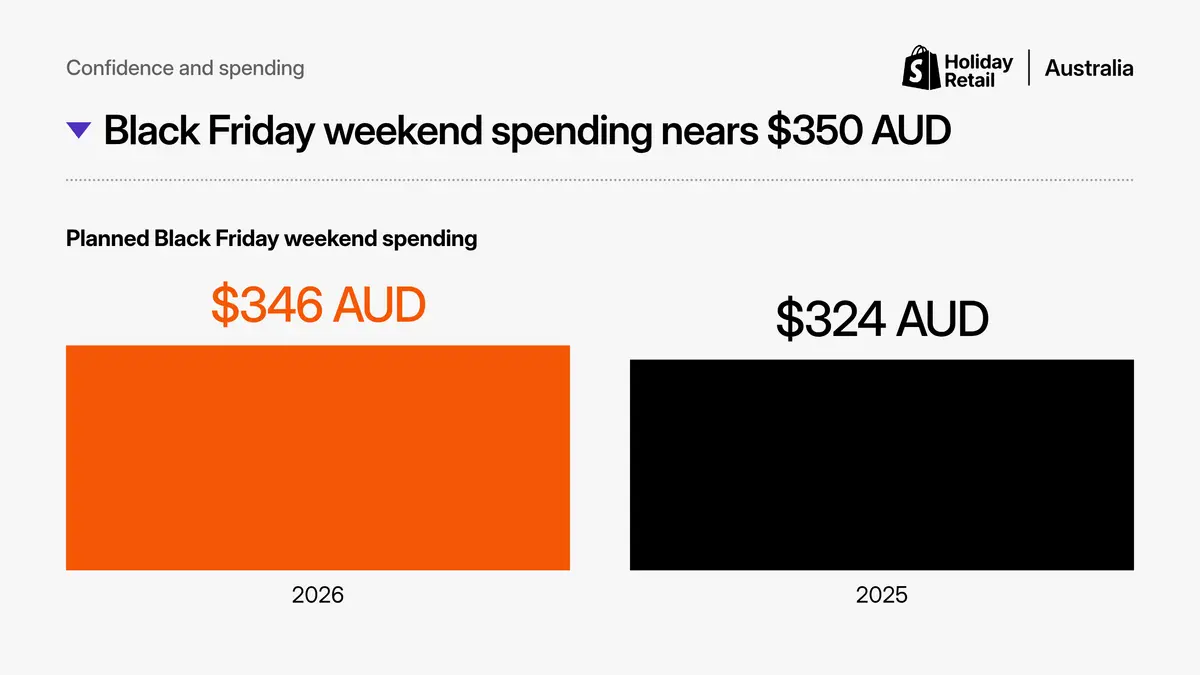
Shopify's 2026 Holiday Retail Report found Australians plan to spend an average of AUD $346 over the Black Friday Cyber Monday weekend, up from AUD $324 a year earlier. Globally, planned spending fell to USD $186 from USD $192.
Even with that increase, the findings suggest consumers remain cautious. More than half of Australian respondents, 54%, said economic conditions had negatively affected their holiday shopping plans, while 85% said they would rather wait and buy the right product than choose the easiest available option.
That more deliberate approach is shaping how people search for products. Some 62% of Australians expect to use AI for at least one holiday shopping task this year, from finding deals to discovering products and inspiration.
Consumers also appear increasingly willing to hand over parts of the buying process to software tools. The research found 51% would let AI recommend the right product, 41% would let it build their cart, and 29% would trust AI to make a purchase on their behalf.
Younger shoppers are more likely to use the technology. Seven in 10 Australians aged 25 to 34 use AI at least occasionally when shopping, compared with 45% of shoppers overall.
James Johnson, Head of Enterprise ANZ at Shopify, said shoppers were still prepared to spend but were taking more care over how they did so.
"Australians are still willing to spend this holiday season, but they're putting more work into deciding what's worth their money," Johnson said. "They're researching, weighing up more options and increasingly using AI to help them find products that fit what they're looking for.
"For retailers, that raises the bar. This BFCM isn't just about offering the deepest discount; it's about making your products easy to discover, clear to understand, and worth choosing. The businesses that get those fundamentals right can give shoppers greater confidence in what they're buying, wherever that discovery starts."
Value focus
The survey points to a shift in how consumers define value. Some 57% of Australians said good value meant getting higher quality than expected for the price, suggesting price alone is not the only factor in purchase decisions.
Online shopping behaviour also reflects that caution. Nearly a quarter, 24%, said they place items in a cart and then wait for the price to fall, using the cart as a watchlist before committing to a purchase.
For merchants, that creates pressure to explain product quality and relevance as clearly as possible while remaining competitive on price during a peak discounting period.
Retailers are responding by investing in AI-related tools and presentation. Some 51% are investing in AI-generated content, 46% in virtual assistants, and 45% in making their stores easier for AI tools to interpret and recommend.
Fleur Brown, Chief Industry Engagement Officer at the Australian Retail Council, said trust would be central as AI took on a bigger role in shopping decisions.
"This peak season will be an important test of how AI fits into the way Australians shop," Brown said. "As more shoppers use these tools to compare products, discover new options and look for better value, trust will be critical. Retailers have an opportunity to use AI to make shopping easier and more relevant, but the fundamentals don't change; customers still need to feel confident that they're getting genuine value and making the right choice."
Brand discovery
The findings also suggest AI may be influencing which brands consumers encounter. More than half of Australians, 54%, said they were choosing independent or niche brands more often than last year.
That tendency was stronger among frequent AI users. Among Australians who almost always use AI when shopping, 80% said they were choosing independent or niche brands more often, compared with 40% of those who do not use AI when shopping.
The research does not show that AI directly caused that shift, but it points to a link between regular AI use and greater openness to lesser-known brands. Some 15% of Australians had already discovered a brand through AI that they had not heard of before.
Princess Polly said its preparation for the shopping period starts with strong retail execution and product information.
"We're seeing shoppers plan earlier every year. Our customers build their wishlists well in advance so they're ready the moment offers go live," said Destiny Flaherty, Head of SEO at Princess Polly. "To capture attention, we're focused on getting the fundamentals right: competitive offers, clear and simple messaging, and a product selection that reflects what our customer actually wants to wear this season."
"In terms of AI, search is moving from keywords to conversations, so we've built a dedicated AEO (answer engine optimisation) roadmap around that shift. It starts with our product data. Our customers expect the latest styles that genuinely match what they're looking for, so we're making sure every product carries the rich, accurate attributes and descriptions AI platforms need to surface it in the right context."