

Twilio bets on conversation infrastructure for the agentic AI era
Tue, 27th Oct 2026 (Today)
Since the first generative AI models and LLMs burst onto the technology scene, the focus has been on making models smarter. The days of AI telling us to eat rocks to get more essential minerals in our diets are, thankfully, behind us.
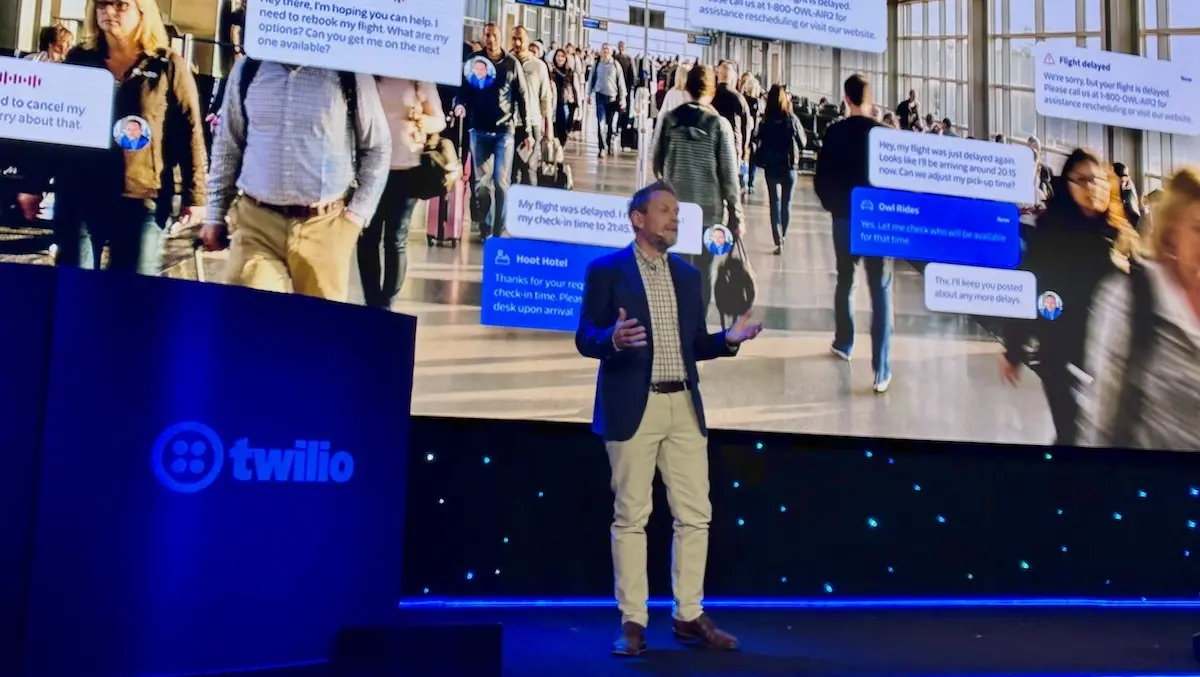
During Twilio's regional SIGNAL event, held in Sydney, the company argued that the next phase of enterprise AI will focus on the communications, data and orchestration infrastructure needed to make AI agents useful in real customer interactions. Twilio sees itself has having an essential role as the infrastructure layer connecting AI agents, customer data, communications channels and human workers.
Twilio's CMO, Chris Koehler, said "The opportunity isn't just to add more AI. It's to make the whole experience better."
Koehler said that smarter AI by itself isn't sufficient. AI agents need access to context, communications channels, identity, enterprise systems and the ability to take actions.
"Intelligence without context is just guesswork. Intelligence without coordination, just noise. And intelligence without infrastructure can't reach the real world," he said.
This point was rammed home by Atlassian's Head of Product for Customer Service Management, Vincent Wong.
As a global company that focusses on creating tools used by teams for collaboration, Wong said gaining access to the deep and valuable knowledge that is often trapped in silos is important. But doing that requires infrastructure that can connect data wherever it is located. And while Atlassian, he said, has deep expertise in creating software, it does not have the in-house skills needed to create a global communications platform.
"AI makes it very, very easy to vibe code your way to a new website on the fly. But what you can't vibe code is a reliable, compliant global communication super network," said Wong.
Without context, coordination and intelligence it becomes impossible for a customer's journey to move between different channels. As consumers, we all know the frustration that comes when we call an organisation and repeat information as we're shunted between different channels. This leads to what Twilio calls the 'conversation gap'.
"The technology got smarter, but the experience got worse. This is not an AI problem. It's an infrastructure problem," said Kathryn Murphy, Twilio's SVP for product. To overcome this gap, Murphy announced a suite of four new capabilities that create a conversation layer.

Conversation Orchestrator maintains a single customer conversation across channels and participants while Conversation Memory carries customer context across sessions, channels, humans and AI agents. Conversation Intelligence analyses conversations in real time for signals and sentiment with Agent Connect providing an open-source toolkit that enables developers to connect their chosen AI agent, model or framework to Twilio.
Rather than trying to provide the best AI model, Twilio wants to own the infrastructure connecting whichever model an enterprise chooses to its customers.
"We want you to bring your own models, to bring your own data, and to bring your own stack," explained Koehler.
Maintaining a long-time Twilio tradition, started by the company's founder and former CEO Jeff Lawson, a live demonstration showing these capabilities come together was deftly executed by Twilio's Chris Connelly and Courtney Harland. In about 15 minutes, the pair vibe coded an eCommerce website complete with MFA customer log-in and a chatbot that could shift between SMS, WhatsApp and voice communications into Microsoft Teams.
"We can combine multiple channels with real understanding about our customers so, very quickly, these generic conversations have become a thing of the past. Even a small startup with an engineering team of one or two can create a personalised customer experience very quickly and easily by connecting components in real time. And these components can be things like voice, messaging, memory, and third-party tools like ElevenLabs to be our speech and text providers," said Harland.
Almost every piece of global research about AI points to the same challenges: prototyping AI is reasonably straightforward but scaling to enterprise grade solutions is hard. Just as we saw digital transformation fall short, AI often fails to meet enterprise expectations.
Twilio argues that communications infrastructure, customer context and governance are critical for achieving AI success. Murphy said AI doesn't eliminate the complexity of different countries, channels, regulations and customer expectations
"It just raises the stakes for getting the foundations right," she said. "The future isn't about choosing between humans and AI. It's about building systems for intelligence, infrastructure and people to work together."