

SUSE targets Australia's industrial edge to drive growth
Thu, 13th Aug 2026
SUSE is sharpening its focus on the ANZ market, targeting industrial edge computing, AI inference and infrastructure modernisation as it seeks to expand beyond its traditional European stronghold.
Best known for its Linux heritage, the company believes Australia's geographically dispersed economy and reliance on industries such as mining, transport, energy and maritime operations create an opportunity for technologies capable of running workloads outside traditional data centres and public clouds.
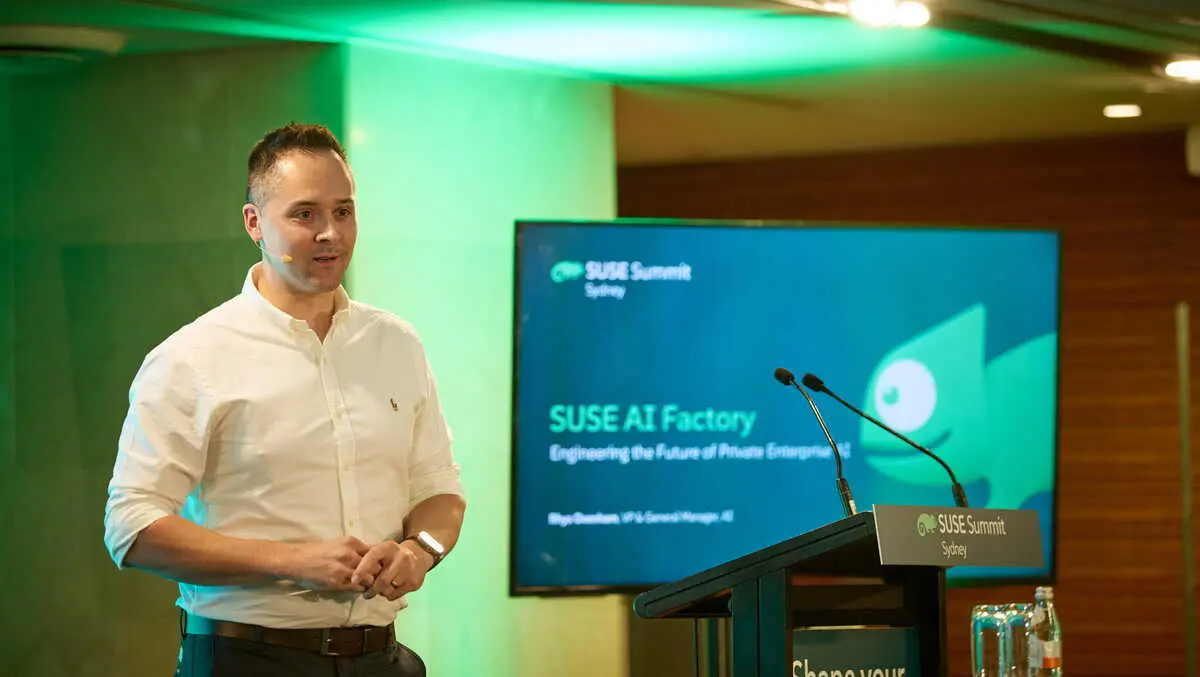
Speaking at SUSE Summit in Sydney, executives said the company had historically been strongest in Europe, particularly among organisations running SAP workloads, but is now seeking to build a more substantial presence across APAC.
The company has diversified significantly from its Linux roots over the past decade.
The acquisition of Kubernetes management specialist Rancher helped push SUSE further into cloud-native technologies, while the company has since expanded into AI, edge computing and telecommunications.
It has also acquired industrial IoT company Losant, which it is using as the foundation for its SUSE Industrial Edge offering.
One of the major opportunities the company has identified is growing demand for digital sovereignty and operational resilience.
Instead of forcing customers to replace existing infrastructure, its strategy is to allow organisations to manage multiple environments through a common platform, according to AI VP and GM at SUSE, Rhys Oxenham.
"Our mantra is: we build one, but we manage many," he said.
The approach is particularly relevant as enterprises increasingly operate a mixture of on-premises infrastructure, public cloud, private cloud and edge environments.
AI moves towards the edge
The executives also expect AI inference to become a major opportunity as enterprises look to process AI workloads closer to where data is generated.
While much of the current AI infrastructure investment is concentrated on training large models in centralised data centres, inference will increasingly take place at the edge.
Oxenham pointed to manufacturing as an example, where computer vision can be used to identify defects in real time on production lines.
Such applications can require extremely low latency, making it impractical to send every piece of data to a distant cloud environment.
SUSE is developing tools that could allow AI systems to interact directly with operational infrastructure.
Its Industrial Edge platform has introduced MCP tooling that can allow AI systems to query deployment infrastructure and operational data.
A future iteration would allow AI to go beyond simply querying infrastructure and instead create operational workflows.
For example, an organisation could ask an AI system to generate an operational equipment efficiency score across its industrial footprint and produce a dashboard based on the underlying workflow, said Global GM & Edge VP at SUSE, Keith Basil.
"These things have to be in place first because it has to have tooling to actually affect the thing that you're managing," he said.
The company sees industries including manufacturing, mining, maritime and energy as particularly attractive.
SUSE has accumulated a significant number of maritime use cases, with its technology being used across different layers of ships, from manufacturing and control systems through to passenger applications running on Kubernetes.
Australia viewed as edge opportunity
Australia's economy is particularly suited to edge computing because of its geographical scale and dependence on physical infrastructure, said ANZ General Manager at SUSE, Ben Henshall.
"Australia, we dig stuff out of the ground, we send it on a ship, we put it on a train," Henshall said.
"It requires huge amounts of energy and utilities to do that."
Australia's freight networks, mines, warehouses, utilities and other distributed infrastructure represent the next frontier of digital transformation, according to Henshall.
Unlike conventional enterprise IT, these environments often involve disconnected networks, harsh physical conditions and equipment that cannot easily be upgraded.
"They've got to be ruggedised. They've got to work in very, very hard, arduous circumstances," Henshall said.
The company believes its existing expertise in lightweight Linux and Kubernetes gives it an advantage in these environments.
Instead of taking cloud software and attempting to shrink it down for edge deployments, its technology was designed to be lightweight from the outset.
Its strategy is based on three areas of edge computing: telecommunications, general edge infrastructure and industrial edge.
SUSE's telecommunications cloud business has already been separated into its own business unit, while its runtime technology is designed to deploy Kubernetes across environments ranging from data centres to wind turbines and satellites.
The Losant acquisition is now being used to build out the industrial edge business.
Challenging the virtualisation status quo
SUSE is also positioning itself as an alternative to established virtualisation platforms following widespread customer concern over rising costs and licensing changes in the market.
IT services company Centorrino Technologies - a "pretty neat Aussie story," said Henshall - has migrated thousands of customer workloads to SUSE as part of its own infrastructure modernisation.
Founder and CEO Adam Centorrino said his team had evaluated several alternatives before selecting SUSE.
Centorrino Technologies has subsequently trained its teams and begun migrating customer workloads, with Centorrino saying it had not charged customers for migrations from its own cloud environment.
The strategy is to allow customers to move away from legacy virtualisation while gradually adopting containers and Kubernetes, rather than forcing an immediate wholesale transformation.
This could be particularly attractive in Australia, where businesses are under pressure to improve productivity while controlling infrastructure costs.
Henshall said SUSE could slash some customers' Linux costs by up to 50 per cent, allowing the savings to be redirected towards AI and other innovation projects.
Partners central to growth strategy
SUSE is also looking to expand its channel ecosystem in Australia and New Zealand, particularly through systems integrators with deep industry expertise.
Basil said the company did not expect SUSE itself to develop every industry-specific application.
Instead, partners could use SUSE's technology as the underlying platform and develop complete solutions for sectors such as manufacturing, mining and public safety.
He pointed to examples in the US where partners had white-labelled SUSE technology as part of their own industrial solutions.
"We are open for business to come in, sit with somebody hand in hand, and stand up a complete business around industrial," Basil said.
The company is also participating in the open-source Project Margo initiative, which is focused on interoperability across industrial edge environments.
Industrial technology is highly fragmented, with different sectors relying on a wide range of protocols and systems.
SUSE's participation in Margo is intended to help establish common standards while allowing the company to incorporate those standards into its Industrial Edge platform.
The broader strategy for the company is to create a consistent infrastructure layer spanning traditional data centres, public cloud, private cloud and the physical edge.