

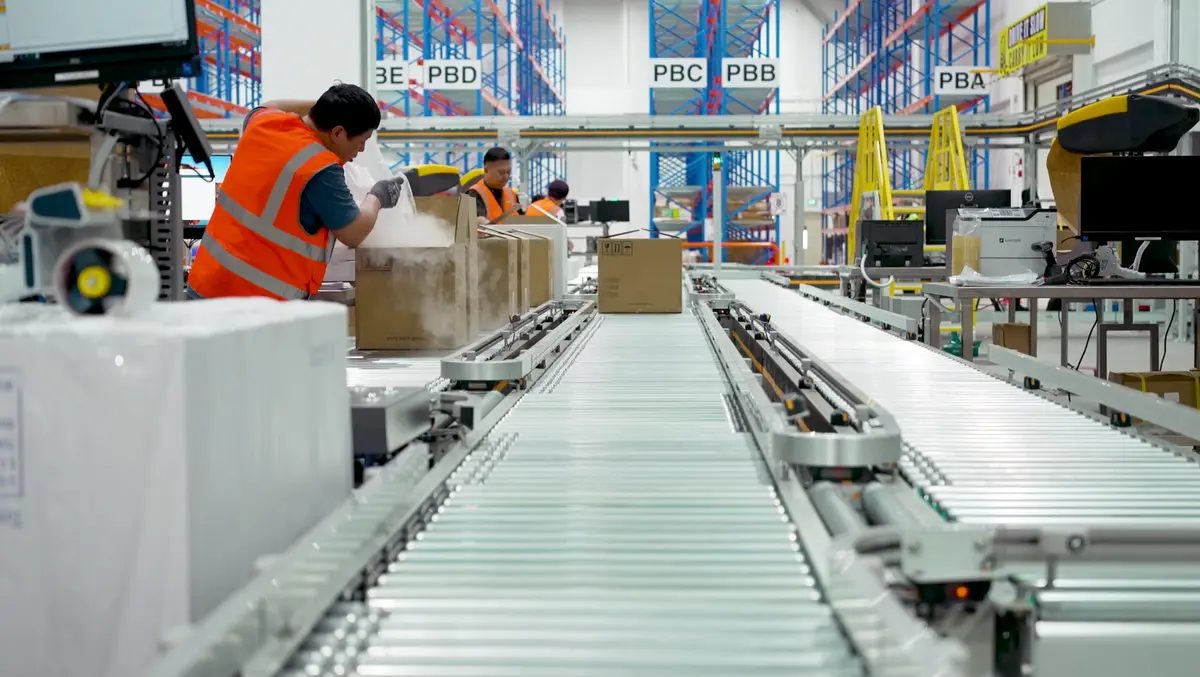

Dematic has installed a modular conveyor system at Bio-Rad's Singapore distribution centre, adding automated sortation and remote controls to packing and shipping operations for Asia-Pacific deliveries.
Bio-Rad Labouratories supplies clinical diagnostics and life science products to hospitals, laboratories and research facilities across the region. The Singapore site serves as a hub for outbound distribution to multiple countries, where delivery timeliness and regulatory compliance are routine requirements.
Rising demand prompted a modernisation project at the facility. The operation handles a wide mix of products and a high number of stock keeping units, increasing the number of decisions required during picking, packing and shipping. Bio-Rad aimed to reduce manual decision-making and lower the risk of packing and dispatch errors.
The project also needed to support cold chain handling. In temperature-controlled logistics, delays between storage, packing and shipping can affect product quality and increase compliance risks when goods cross borders under strict handling, labelling and traceability rules.
System design
The solution uses Dematic's modular conveyor system, built from conveyor segments that can be configured for different layouts. It automatically diverts items to specific packing stations and routes completed cartons to outbound shipping lanes.
Dematic says the design reduces decision points on the warehouse floor and removes bottlenecks that occur when staff pause to determine where items should go next. Control software is integrated into the set-up and uses operational data during packing.
"Once items are picked and placed on the conveyor, everything is managed automatically," said Terence Chan, Senior Sales Manager, Dematic Asia. "The system diverts each product to the correct packing station, using the appropriate packing materials based on real-time data. From there, finished cartons are routed to the correct shipping lane for outbound processing."
Transfer technology
The conveyor design uses powered right-angle transfer technology (RAT) rather than compressed air-based transfer equipment. Right-angle transfers move cartons or totes between perpendicular conveyor lines, which can be important where space is constrained or where multiple packing and shipping routes intersect.
"This not only reduces capital expenditure (CAPEX) but also lowers ongoing maintenance requirements, making the solution more sustainable and cost-effective for Bio-Rad," said Chan.
Maintenance planning is a key focus in warehouse automation because stoppages can cascade through connected processes. In packing and shipping, an outage at a transfer point can slow conveyor induction, create queues at packing benches and affect departure times for outbound lanes.
Remote controls
The system uses cloud-based controls that give authorised users remote access. This allows diagnostics and configuration changes without requiring an on-site presence for every adjustment.
"With Dematic's system architecture, authorised users can access diagnostics and make adjustments from anywhere with an internet connection," said Chan. "This capability proved invaluable during the commissioning phase and remains a huge advantage for ongoing support."
Remote access and monitoring are now common in warehouse systems, particularly for regional operations where technical teams may be in different countries from the facility. It can also shorten response times when faults occur outside normal working hours.
Implementation work
The installation supports products ranging from small vials to larger diagnostic equipment. This variation increases the need for correct handling and appropriate packing materials, and raises the consequences of errors-especially for shipments requiring temperature control or specialised packaging.
Dematic and Bio-Rad completed testing and commissioning, adjusting equipment settings as part of system tuning. This phase included accuracy checks at diversion points, validation of routing logic and confirmation that cartons reached the correct shipping lanes.
Dematic reports that, after go-live, packing times fell and accuracy improved. It also says the cold chain process now moves faster, with greater control over the steps between storage and dispatch.
"The system has had a significant impact on Bio-Rad's operations by streamlining and simplifying key processes. With the technology now managing all sorting and packing decisions, errors have been reduced and workflows have become noticeably smoother. This has allowed the team to concentrate on maintaining high levels of quality and efficiency," said Chan.
The Singapore deployment reflects a broader move in life science supply chains towards more automated fulfilment, particularly where product integrity and compliance depend on consistent processes. Dematic says the Singapore design reworked the end-to-end packing and shipping workflow rather than automating a single step.