

%201.webp)
Shopify has introduced Canvas, a design workspace that lets merchants build online stores with its AI assistant, Sidekick. The tool is rolling out to merchants over the coming days.
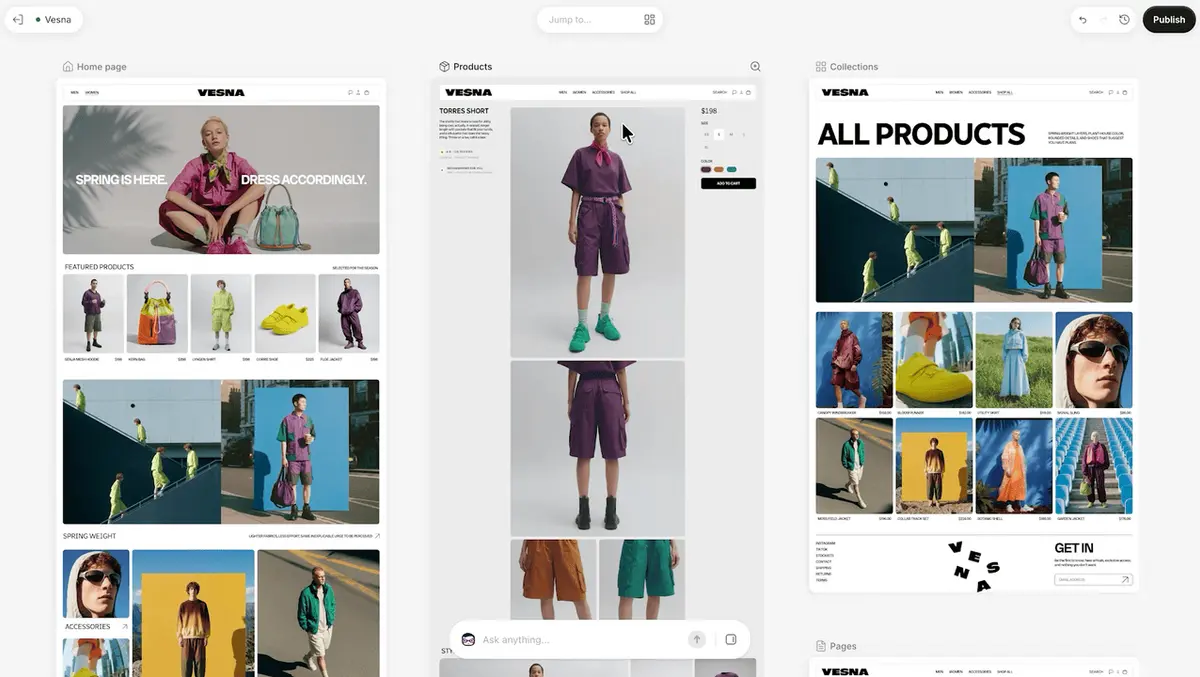
Canvas brings a store's pages, design elements and design system into one interface, where merchants can move across layouts, zoom into details and preview changes before publishing. Shopify says it is built for businesses of different sizes and is intended to reduce the need for design or coding expertise, whether for minor updates or broader redesigns.
The launch expands Shopify's use of generative AI in its merchant tools. Sidekick already writes code for apps and custom theme sections, and Shopify says it made more than 25 million theme edits in the first half of 2026.
With Canvas, merchants can click directly on store elements to edit them or use natural-language prompts in a chat with Sidekick instead of navigating settings panels. AI-generated changes appear in the workspace in real time, letting merchants assess them in the context of the whole store.
Store design
Canvas is designed to present the entire online store as a working environment rather than a static preview. Merchants can review pages with interactivity and animation, and inspect how key pages appear across different products, collections and screen sizes.
Sidekick now also works directly on a theme's files. This allows the AI to handle tasks across templates and files, validate the code it produces, and review screenshots of the resulting design before returning the work to the merchant.
According to Shopify, changes to theme architecture have made store structure, logic and design easier for Sidekick to interpret and modify. That supports work ranging from updates to individual sections to full redesigns.
Ben Sehl, Director of Product at Shopify and Co-Founder of Kotn, linked Canvas to a broader effort to lower the barriers to custom storefront design. "When I built Kotn 12 years ago, I knew how to code and it still took me two weeks to get a rough store working," Sehl said. "Today, an entrepreneur on Shopify can build a fully custom store in twenty minutes that's head and shoulders above what I built then. That's what we're enabling with Canvas: helping more entrepreneurs get closer to the version of their store that exists in their head."
AI workflow
Shopify describes Sidekick in Canvas as a collaborator that asks questions, suggests approaches and remembers earlier design preferences as work progresses. Both the merchant and the AI work from the same visual design surface, allowing each change to be reviewed as it appears.
Austin Knight, Design Director at Shopify, outlined the challenge of extending an AI coding assistant into design work. "Getting Sidekick to write code was easy, but guiding it to make good design decisions took a great deal of time and attention," Knight said. "Every theme has a unique design contract, a curated set of patterns to draw from, and a mountain of opinionated eval data. The result is that Sidekick brings merchants tasteful, distinct design directions that become a springboard for their own creativity."
Shopify is positioning Canvas as an additional interface rather than a replacement for the current editor, suggesting it is using the release to gather merchant feedback as development continues.
Sehl said the rollout is still at an early stage. "We couldn't wait to put it in the hands of merchants who want to explore, play, and help us shape what comes next," he said. "We're early here and Canvas is not replacing the existing editor yet. Things will change quickly, and there are gaps we still need to close. In the meantime, we're excited to build alongside you."